Annotated Bibliography
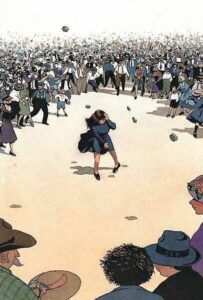
“Annotated Bibliography” by Nery Bonilla
Bailey, Ted. “Sacred Violence in Shirley Jackson’s ‘The Lottery.’” British and American Studies,
vol. 20, 2014.
In this article, Ted Bailey explores the idea of sacred violence in “The Lottery.” He argues that
the violent ritual in the story stands for how societies use tradition and religion to justify cruelty.
Bailey explains that the people in the see the lottery as normal and necessary, even though it
causes death. He connects this to real-world examples of people accepting violence when culture
or authority supports it. This source will help me explain how The Lottery is not just about
cruelty but about how communities create and continue harmful traditions. It also supports the
idea that Jackson used horror to show how people follow rules without thinking, which connects
to the theme of social pressure in my essay.
Robinson, Michael. “Shirley Jackson’s ‘The Lottery’ and Holocaust Literature.” Humanities, vol.
8, 2019.
Michael Robinson compares Shirley Jackson’s The Lottery to stories about the Holocaust. He
argues that both show how ordinary people can take part in terrible acts when they follow orders
or traditions. Robinson explains that Shirley Jackson’s story uses the setting of a small town to
make readers see how easily evil can hide in normal life. He also says that the story forces
readers to question their own choices and society’s obedience. This source is useful because it
connects The Lottery to real history and shows how Jackson’s story stands for larger human
problems. It helps me show that Jackson’s writing was not just about fear but also about
responsibility, morality, and the danger of not thinking for yourself.
Hattenhauer, Darryl. “Shirley Jackson, American Gothic.” SUNY Press, 2003.
In “Shirley Jackson, American Gothic” the author Darryl Hattenhauer examines the life and work
of Shirley Jackson and how she helped improve the gothic genre. Turning it into something more
psychological. Author Darryl Hattenhauer argues that Jackson’s stories turn away from
traditional Gothic settings and instead focused on the darkness within people and places. He
explains that her fiction explores how social expectations, gender roles, and the need to conform
can become a kind of horror in themselves.
The author also talks about how Jackson’s firsthand experiences influenced her writing. He
connects these experiences to her characters, who often feel trapped or misunderstood. Using
examples from stories such as “The Lottery” and “The Hunting of Hill House,” Darryl
Hattenhauer shows how Jackson exposes the cruelty and fear hidden within small towns and
families that are normal. He believes Jackson used the Gothic style as social criticism, to show
how society’s rules and expectations can destroy individuality.
Darryl Hattenhauer’s purpose is to present Jackson as a serious and important American writer,
not just a creator of horror stories. Writing for a college audience, he uses ideas from literature,
history, and Jackson’s own life to explain that her stories show the emotional and social
problems of her time. He says that the real “monsters” in Jackson’s stories are the fear,
judgment, and pressure that exist in everyday life.
I found this essay interesting because it helped me understand Shirley Jackson’s writing better. I
agree with his idea that Jackson used horror to show the darker side of everyday life like the
people around us. Her stories, like The Lottery, are scary because it shows how people can
follow cruel traditions. I also liked how Hattenhauer connects her personal life to her stories it
made me see how her feelings and struggles shaped her writing. Sometimes the essay includes a
lot of detail and analysis, but his main point is clear, Jackson’s horror comes from society itself.
That still feels true today because people still face pressure to fit in or be someone they are not.
Overall, Hattenhauer’s essay helped me understand the Shirley Jackson is more than just a writer
of scary stories. His analysis shows how her work reveals the dark side of ordinary life and the
danger of needing to fit in. Reading this made me appreciate how writers can use horror to tell
more stories about society.

